Quick Answer
• AI delivers real ROI when built on clear foundations — not just dropped into chaos
• Best results come from repurposing existing content, automating repetitive tasks, and custom-trained assistants
• Common failures happen with vague prompts, missing brand voice, and over‑automation
• Success requires strategy, clear voice guidelines, and realistic expectations about what AI can do
TL;DR
Most solopreneurs hear how AI saves “10+ hours a week,” but what that actually looks like depends heavily on how you use it. When it’s set up with strategy, voice, and clarity, AI can deliver genuine ROI. When it’s not, it can feel like another burden rather than a business asset.
Introduction
If you’ve been wondering, “Does AI actually save time for small businesses, or is it just marketing hype?” here’s the direct answer: it depends entirely on how you set it up and what you’re asking it to do.
I’ve seen both sides — clients who’ve transformed their content creation and others who’ve wasted weeks trying to make generic AI tools work for their specific business needs.
In this post, you’ll discover real examples of where AI delivers measurable returns, where it commonly falls short, and a practical checklist to help you decide if it’s right for your business right now.
What’s the Reality Behind AI Time‑Saving Claims?
Mini‑summary: What “10+ hours saved” usually means in practice
To answer this directly: those impressive time‑saving claims are real, but they’re not automatic. They depend on having the right setup, clear processes, and realistic expectations about what AI can and can’t do.
The current situation is that many business owners try AI tools expecting immediate magic, but end up frustrated when the reality doesn’t match the marketing promises.
Here’s what actually drives those results:
• Systems and structure — knowing what you want AI to help with
• Clear brand voice — so outputs don’t need complete rewrites
• Strategic setup — focusing on high‑impact, repetitive tasks
• Realistic expectations — understanding you’ll still need to review and refine
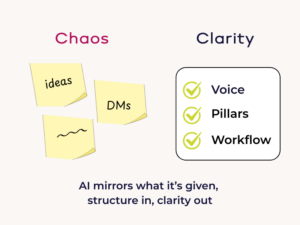
One client initially expected AI to handle everything instantly, but quickly realised that the setup phase was essential. Once we established her brand voice and content pillars, her custom GPT became genuinely helpful rather than just another frustration.
Key takeaway: You need systems, structure, and voice clarity to get results that actually work for your business, not just impressive‑sounding outputs.
What Are the Real AI Success Stories?
1) Repurposing Existing Content Across Multiple Platforms
Many small businesses have blog content sitting dormant on their websites. AI can transform old blog posts into newsletters, social media captions, carousel graphics, and more. It’s not about generating new ideas — it’s about maximising what you’ve already created.
One client used this approach to revive a year’s worth of blog content and create a month’s worth of social posts in just a couple of hours. The content was already proven and in her voice — AI simply helped reshape it for different formats.
2) Automating Repetitive Tasks with Smart Workflows
If you’re spending time copying and pasting information between systems, AI combined with automation tools like Make.com or Zapier can free up significant time. This includes automating email triggers, post scheduling, or form follow‑ups. Which tool you choose depends on integrations, price and how visual you want your builder to be; both are viable for SME workflows.
As one client told me: “The mental relief of having fewer tabs open and fewer manual tasks is just as valuable as the time saved. I can actually focus on the creative work now.”
3) Using Custom GPTs for Specific Business Tasks
With a trained GPT that understands your voice and business, you can quickly prep podcast summaries, draft outreach messages, or outline client presentations. (ChatGPT Plus, Team or Enterprise accounts can create custom GPTs.)
One client said: “My GPT now handles the messy middle of content creation, so I can focus on refining and adding the personal touches that really matter.“
The current picture: UK SME adoption sits at roughly one‑third and rising — think low‑to‑mid 30% reporting active use, with daily users more likely to see productivity and revenue benefits. Headlines quoting “over half” usually reflect broader “using AI for something” measures or specific functions like content creation. The conservative takeaway is: AI is moving mainstream, not universal yet.
Context that keeps expectations realistic: Most firms see modest, operational impacts first (workflow efficiencies, fewer manual steps) before any big structural changes. That aligns with a structure‑first approach: build the foundations, then expand what works.
Key takeaway: The biggest wins come from applying AI to tasks you’re already doing repeatedly, not trying to invent entirely new processes.
Where Does AI Commonly Fall Short?
Mini‑summary: The typical failure points that waste time rather than saving it
Here’s where I see AI implementations go wrong most often:
• Vague prompts lead to vague results — without specific instructions, you get generic outputs
• Missing brand voice guidelines — AI defaults to corporate‑speak that doesn’t sound like you
• Over‑automation without oversight — mistakes multiply when there’s no human review
• Unrealistic expectations — expecting AI to read your mind or replace strategic thinking
I worked with a client who initially tried using generic ChatGPT for all her content creation. She was spending more time rewriting AI drafts than writing from scratch, because she hadn’t given it any context about her voice or audience. It created confusion rather than clarity.
Once we built her brand voice guide and trained a custom GPT, the same technology became genuinely helpful instead of frustrating.
Key takeaway: You still need human thinking, strategy, and editing — AI speeds up the execution, but it doesn’t replace the planning behind it.
What’s the Real ROI Equation for Small Businesses?
Mini‑summary: Breaking down what actually creates value versus what just sounds impressive
Mini‑summary: Breaking down what actually creates value versus what just sounds impressive
| What Works Best | Why It Works | What You Still Need |
| Time saved on admin | Less manual work, more creative space | Prompts and workflows built around your specific business |
| Content consistency | Regular online presence without burnout | Content pillars and brand voice guide already established |
| Mental clarity | Less decision fatigue, clearer direction | Clear task setup and human oversight on final outputs |
The practical difference is that successful AI implementation feels like having a skilled assistant who understands your business, whilst failed attempts feel like training an intern who keeps missing the point.
Key takeaway: The real ROI comes from reducing cognitive load and repetitive tasks, not from eliminating human involvement entirely.
Is AI Right for Your Business Right Now?
Mini‑summary: A practical checklist to assess your readiness
Use this assessment to determine if AI could work for you now:
• Are you spending more than 3 hours per week on repetitive admin or content tasks?
• Do you already have content (blogs, newsletters, outlines) that could be repurposed?
• Do you know what your brand voice sounds like when written down?
• Are you open to testing and refining instead of expecting immediate perfection?
• Do you have basic workflows, or are you ready to establish them?
If you answered yes to 3 or more questions, AI could be working for you now — especially with a Custom GPT Build.
If you answered yes to fewer than 3, it may be time to work on your voice, structure, and systems first. As one client realised: “I needed the Foundation step before my GPT could work well — trying to skip that just created more confusion.”
Key takeaway: Your readiness for AI depends more on your business clarity and existing processes than on your technical skills.
FAQs
How quickly should I expect to see ROI from AI tools?
Most clients see early time savings within 2–3 weeks of proper setup, with more noticeable gains over 2–3 months as processes bed in and prompts improve.
What’s the difference between free AI tools and paid solutions?
Free tools work for occasional use, but paid solutions (like ChatGPT Plus, Team or Enterprise for custom GPTs) offer memory and customisation that make daily business use more effective.
How do I know if my AI setup is actually working?
Track specific metrics: time spent on content creation, number of drafts needed, and how often you use the AI versus avoiding it. Helpful AI feels like support, not friction.
What if I’m not technical enough to set up AI tools?
The technology setup is often simpler than the strategy work. Most AI failures come from unclear instructions rather than technical problems.
Should I try to automate everything at once?
Definitely not. Start with one repetitive task, get that working well, then expand. Trying to automate everything simultaneously usually creates more problems than it solves.
To summarise: AI can create genuine returns for small businesses, but it’s not the technology that does the heavy lifting; it’s the clarity and strategy you bring to it.
The key insight here is that successful AI implementation feels calm and supportive, like having a skilled team member who understands your business. Failed attempts feel chaotic and add to your workload rather than reducing it.
With the right foundations. clear voice, defined processes, and realistic expectations — AI becomes a genuine business asset rather than just another tool to manage.
Book a Foundation Package to get your brand voice, content pillars, and systems sorted first. Or if you’re already clear on your messaging, schedule a Custom GPT Build and let’s get your AI assistant working like a genuine part of your team. Click the link below.