Quick Answer
- ChatGPT remembers context in the current chat and, with Memory on, can remember details across chats you allow it to save..
- A custom GPT starts pre-loaded with your voice, offers and files, which cuts repeat briefing, even though custom GPTs themselves don’t use Memory yet.
- Choose custom if you’re constantly rewriting or re-explaining your business
TL;DR
If you’re tweaking every word or re-explaining context on each chat, you’re ready for a custom GPT. A good one remembers your voice and offers, so you create faster without losing tone.
Introduction
If you’ve been wondering, “Should I build a custom GPT or just stick with ChatGPT?” the question really comes down to how often you write and how tired you are of fixing generic drafts. If you’re spending more time editing than publishing, it’s not you – it’s the lack of shared context.
My thoughts, ChatGPT is brilliant for ideas and one-offs. A custom GPT starts where you are, with your voice and offers already loaded, so you’re not rebuilding the brief every time. In summary, this post shows when to keep it simple and when to go custom.
In this post, you’ll discover the real differences between these tools, when each one works best, and how to know if you’re ready to make the jump to a custom solution.
The Real Difference Between ChatGPT and Custom GPTs
Mini-summary: Same engine, different starting context. ChatGPT can remember you when Memory is on; a custom GPT starts pre-loaded with your business.
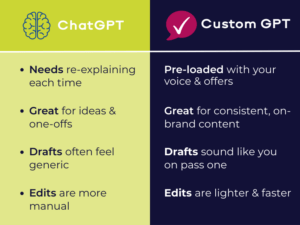
ChatGPT (baseline)
- Remembers context inside the current chat
- With Memory on, can remember preferences and facts across chats you allow it to save
- Custom instructions apply to new chats by default
- Great for brainstorms, summaries, one-offs
- May still feel generic without brand samples in that conversation or project
Custom GPT (trained on you)
- Pre-loaded with your voice, offers, phrasing and Knowledge files
- Starts from shared context every time, so fewer repeats
- First drafts land closer to you on pass one
If you need to create your Brand Voice and Ideal Client Avatar then check out my Foundation Package here.
Note: Memory isn’t supported inside custom GPTs yet, so treat each session as fresh, but already briefed via its setup.
Key takeaway: Decide on volume and brand consistency needs, Memory helps ChatGPT remember you, while a custom GPT starts briefed with your materials
When Is ChatGPT Actually Enough?
Mini-summary: Use it when consistency doesn’t matter and you’re exploring.
Situations where the basic version works perfectly
There are definitely times when the basic version is perfectly fine for your needs:
- Quick social post ideas when you just need inspiration
- Brainstorming content topics for future planning
- Experimenting with tone or messaging when you’re still exploring
- Fast help summarising documents or research
- One-off tasks that don’t require brand consistency
If you’re early in your AI journey or still refining your brand voice, this is actually a great place to start. You can learn how AI works without the commitment of building something custom.
Key takeaway: ChatGPT is a great entry point, but it has clear limits for brand consistency.
Check out my blog “AI Isn’t the Enemy. Chaos Is,” to see if your business is ready for AI.
When Does a Custom GPT Make the Real Difference?
The signals that indicate you’re ready for something more sophisticated
Mini-summary: If you’re repeating yourself, you’re ready.
If you’re saying “It still doesn’t sound like me,” “I’m rewriting everything,” or “I explain my business in each new chat” (unless Memory is on), a custom GPT will make a real difference.
“I was struggling to get AI to create content that actually sounded like me, until I worked with Jacqueline. Now my content feels authentic, and my messaging is clearer.” – Eloise Elford
That’s not just a time-saver – it’s a confidence shift. When your AI assistant understands your voice from the start, creating content becomes energising rather than draining.
Key takeaway: Custom GPTs turn frustration into clarity and speed — without losing your voice.
What Do Custom GPTs Actually Do?
What Do Custom GPTs Actually Do?
Mini-summary: One small prompt → a real first draft in your voice.
Prompt I actually use:
“Draft a 400–600 word email/blog on {pillar/topic} using my Brand Voice DNA. Keep sentences short, add one key takeaway, and end with a reflective question. Use UK English.”
Where this helps most
- Consistency: first drafts already sound like me, so I edit instead of rebuild
- Speed: fewer back-and-forth prompts because the context is pre-loaded
- Focus: I can spend time on ideas and examples rather than formatting tone
My assistants (named for clarity): Lucy — longform drafts; Carrie — carousels; Viv — voiceover scripts
Key takeaway: Small, repeatable prompts beat long tool lists — especially when your voice is pre-loaded.
Micro-case:
Client: Jacqueline (me)
Before: ~2 hours plus per blog end-to-end
After: ~30 minutes per blog (4 blogs in 2 hours using Lucy for research, drafting and edits)
What changed: Brand Voice DNA, clear pillars, one repeatable prompt
By the numbers:
- Custom GPTs built to date: [add your live count]
- Drafting time change: from [your old average] to ~30 minutes per post
- Typical weekly time saved: ~1.5 hours per post × [your posts per week]
Key takeaway: One concrete before/after builds more trust than ten promises.
I love building Custom GPTs, and if you would like my expertise to build yours, here’s how I can work with you.
Isn’t This Just AI Taking Over My Creativity?
Addressing the most common concern about custom AI assistants
This comes up constantly, so let me address it directly: there’s a big difference between automating and abdicating.
A custom GPT shouldn’t take over your thinking – it should support it.
It’s not about handing over your creativity. It’s about:
- Having a trained assistant who knows your tone, your offers, and your clients
- Getting a real first draft instead of a robotic template
Making it easier to start creating, not harder • Reducing the mental load of explaining context repeatedly
I say this in every workshop: “Don’t let AI take the thinking away from you.”
AI is a tool, not your friend; keep the thinking human, let the tool speed the doing.
Key takeaway: You’re the brain; AI is the assistant.
Should You Build a Custom GPT Now?
How to know if you’re ready for this investment
Mini-summary: A quick gut-check.
- Yes to custom if you publish weekly and edit more than you write
- Try ChatGPT if you’re still shaping your voice or have few samples
Key takeaway: Decide based on volume and voice clarity, not hype.
Yes, if you:
- Want to save hours per week without sounding generic
- Have a clear offer and tone, but need help showing up consistently
• Are already using ChatGPT but doing too much heavy lifting - Have existing content that represents your voice
Not quite yet, if you’re:
- Still refining your core message
- New to using AI and want to experiment first
- Don’t have written content or voice examples yet
- Unsure about your brand voice or ideal client
If that second list sounds like you, start with my Foundation Package. We’ll build your brand voice and ideal client avatar first, so you’re ready to train a GPT properly when the time comes.
Key takeaway: Build a custom GPT when you’re ready to scale your content creation without losing your authentic voice.
Updated: Free users can use shared GPTs / GPT Store. Creating or publishing requires a paid plan.
FAQs
How much time does a custom GPT actually save?
Most clients save 5–10 hours a week because they start from a real first draft, not a blank page.
Will it sound exactly like me?
It’ll be much closer than generic ChatGPT. You still review and tune. Think “great first draft”.
Can free users access custom GPTs?
Yes — free users can use GPTs that are shared with them or found in the GPT Store (with message limits). Creating or publishing a GPT requires a paid plan (Plus/Pro, Team or Enterprise).
How long does it take to build a custom GPT?
A few hours once your voice samples and requirements are ready. The prep is the work.
Can I update my custom GPT as my business evolves?
Yes. You can refine as your messaging evolves.
Conclusion
To summarise: the choice isn’t tech, it’s context and consistency. Keep ChatGPT for quick ideas. Build a custom GPT when you want drafts that start in your voice.
Start with the Foundation Package if voice and client clarity need work. To complete my enquiry form, click here.