Quick Answer
- If your writing feels stiff or not you, the gap is voice and structure, not ability.
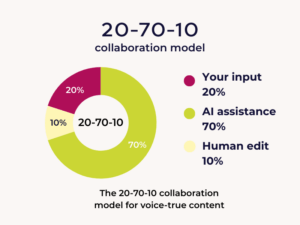
- Use 20, 70, 10: 20% your direction and tone, 70% AI assistance for structure and draft, 10% your final edit for authenticity.
- Expect comfort in about six months of steady practice, with ongoing refinement.
TL;DR
AI did not find my voice, I did, and AI helped me express it consistently. With 20, 70, 10, drafts start closer to you, editing gets lighter, and time drops from hours to under an hour, without losing warmth.
Introduction
Every small business owner knows that moment. You’re staring at a blank screen, cursor blinking, trying to write social media content that doesn’t sound like a corporate press release. You want to share your expertise, engage your audience, sound relatable.
However, everything you write feels off. Too corporate. Too stiff. It does not capture the warmth you have in face‑to‑face conversations. Your message gets lost in business jargon, and the importance of what you actually do doesn’t come through. Worst of all, when you read it back, you think ‘that doesn’t sound like me at all.’
Your expertise is there, but your personality has disappeared.
That was me three years ago.
The Corporate Speak Trap
Coming from a traditional business background, my natural writing style was corporate‑speak. Every sentence felt like it belonged in a quarterly report rather than a genuine conversation with potential clients.
Meanwhile, I watched younger entrepreneurs creating content that felt conversational and engaging. They’d post something on LinkedIn that sounded like they were chatting over coffee, and the engagement would pour in. Their personality shone through every word.
The gap between what I knew and how I could express it felt insurmountable.
I’d sit at my desk, sometimes for hours, trying to write a simple social media post. I’d draft it, delete it, try again, give up. The cursor would blink at me, almost taunting. I called it my “blinking cursor of doom.”
The frustration wasn’t just about marketing. It was deeper than that. I knew I had valuable things to say. I knew I could help people. But I couldn’t translate that knowledge into words that felt authentic and accessible.
Sound familiar?
What “Simply Wrong” Actually Means
When I talk to business owners about their content struggles, they often say the same thing: “It just feels wrong.”
So what does “wrong” actually mean? Understanding this is the first step to fixing it.
It means your content doesn’t carry the importance of what you do. You’re brilliant at your work, whether that’s coaching, consultancy, design, training, or any other service. But when you try to write about it, that brilliance gets buried under cautious language and business clichés.
It means you struggle to get your message across. You know exactly what you want to say when you’re talking to someone face‑to‑face. But translating that clarity into written words feels like trying to speak a foreign language.
It means your personality disappears. The warmth, humour, wisdom, and experience that make you excellent at what you do vanish when you write. You sound like every other business owner using the same tired phrases.
It means you feel like an imposter. When you read your own content back, you don’t recognise yourself. It sounds like you’re pretending to be someone more “professional” or “business‑like” than who you really are.
For years, I battled this. I’d write something, hate it, force myself to post it anyway, then cringe every time someone engaged with it. Because I knew it wasn’t really me.
Then I discovered AI. Not the Hollywood version that’s going to replace us all, but the practical kind that helped me find my voice.
My Three‑Year Journey (The Laughable Beginning)
Let me be honest about something. My first attempts with AI were laughable.
Everything came out sounding over-enthusiastic and not like me. Peppered with those dreaded em dashes I would never use in real conversation. And the rocket emojis appeared in everything. It was like my content had been written by an over‑caffeinated Silicon Valley marketing department that had never heard of British understatement.
“Ready to revolutionise your business? Let’s dive into strategies that will transform your workflow!”
That’s not me. That’s not how I talk. That’s not how I think.
But here’s what I did differently from most people who try AI once and give up: I persisted.
I learned to prompt better. I discovered how to train AI on my specific style and needs. I experimented with different approaches. I made mistakes, learned from them, and tried again.
And slowly, something began to click.
The Breakthrough: Understanding the 20, 70, 10 Model
The real breakthrough came when I understood the collaboration ratio between me and AI.
Initially, I thought it worked like this: 10% me at the start, 80% AI in the middle, 10% me editing at the end. I thought I was handing over content creation to a robot and just checking its work.
However, that’s not how it works, not if you want content that sounds authentically like you.
As my skills developed, I realised the ratio is different:
20% of my input at the start, my ideas, context, direction, personality. This sets the tone and gives AI raw material.
70% AI assistance in the middle, structure, development, drafting, expanding ideas. The AI helps organise thoughts and express complex ideas clearly.
10% of me at the end, editing, refining, ensuring it sounds like me. This final step adds human context and nuance that only I can provide, and removes anything that feels corporate.
That final 10% makes the difference between AI‑generated and AI‑assisted content, between sounding like everyone else and sounding like you.
From Personal Struggle to National Recognition
What started as a personal struggle became something bigger.
I applied to the Woman Who UK Solopreneur Awards in 2024 for my previous VA business and was a finalist. In October 2024, I pivoted to an AI‑focused business. When the 2025 awards came around, I almost didn’t apply.
I thought, “I’m a fledgling business. I don’t know if this will work long‑term.”
But I loved the work. Clients were getting results. So I applied anyway.
In 2025, I won the Woman Who Solopreneur Award. At 65, I had pivoted from traditional VA services to AI specialist and thought leader. The judges said: “To pivot a business can be tricky, but to pull it off at 65 in an area associated with Gen Z is truly impressive.”
That recognition was validating. It also proved something important: AI enhances who you are rather than replacing you.
The judges did not recognise me for becoming a tech expert. They recognised me for making AI accessible, for helping other business owners find their voices, and for proving that age and experience are advantages, not barriers.
When your content sounds like you, people notice. They engage. They remember. They trust you enough to work with you.
What AI Actually Does (and Doesn’t Do)
AI did not find my voice for me. I found my voice, and AI helped me express it more effectively and consistently.
AI does not write for you. It writes with you.
Think of it like a very good editor who knows your style, understands your audience, and helps you structure your thoughts. This editor is available 24/7 and does not judge rough drafts.
AI helps you when:
- You know what you want to say but cannot find the words
- You need to express complex ideas more simply
- You want consistency across platforms
- You are stuck for a compelling opening or strong close
- You need to write regularly but your energy fluctuates
AI does not help you when: - You do not know what you think or believe
- You have not done the work to understand your audience
- You try to use it as a replacement for your expertise
- You skip the final 10% of human refinement
The businesses getting the best results understand this distinction.
The Practical Reality of Learning AI
I will not pretend this transformation happened overnight, and there is no finish line where you have mastered AI and are done. The truth is more nuanced.
The first months were about unlearning bad habits. I stopped trying to sound more “professional” and started sounding like me. The AI could only help me sound like me if I knew what that sounded like.
Then came experimentation. Trying prompting techniques. Working out how much context AI needed. Discovering what inputs produced the best output. Messy and uncertain, but essential.
Around month three, things felt practical. I got better at the crucial 10% editing phase. I learned to spot when something sounded off and how to fix it.
By month six, I felt comfortable. Creation that used to take 3–4 hours took 30–45 minutes. More importantly, I enjoyed the process rather than dreading it.
It does not stop there. Three years later, I am still learning. I update custom GPTs as my tone grows stronger. The tools evolve. My business evolves. My voice evolves with experience and confidence.
This is not about reaching a destination and “completing” AI. It is a skill that grows with you, adapting as your business and the technology develop.
Now, working with AI feels like any other business tool. It is part of my workflow, and I keep finding new ways to use it effectively.
Why This Matters for You
If you are thinking “I am not technical,” or “AI sounds complicated,” or “I am too old to learn this,” you are exactly who I am talking to.
Because I felt those things too.
I am 65. I remember struggling with my first computer, my first mobile phone, my first social media post. I am not naturally technical. I am sceptical of shiny trends.
AI is different because it is about communication. If you can describe your business challenge, AI can help.
The question is not whether you can learn this. The question is whether you will invest a few months getting comfortable with a tool that could transform how you run your business.
Here is what you gain:
- Hours back each week
- Content that sounds like you
- Consistency across your marketing
- Confidence in your messaging
- Energy for the work you do best
Here is what you do not lose: - Your personality
- Your expertise
- Your authentic voice
- Your client connection
- Your competitive advantage
Your Next Steps
If the blinking cursor has been defeating you, there is a better way.
You do not need to be a tech expert. You do not need to be younger, more digitally native, or more “creative.” You need to be willing to experiment with a tool that helps you express what you already know in natural, authentic ways.
Start small. Have a conversation with AI about your business. Describe a challenge you are facing. Ask it to help structure an idea you have struggled to articulate.
Remember 20, 70, 10. Your voice at the start, AI assistance in the middle, your refinement at the end.
Be patient with yourself. This is a skill. It takes practice. Unlike most skills, this one gives back time rather than consuming it.
Three years ago, the cursor defeated me. Today, I help business owners across the West Midlands transform their relationship with content creation, and I have won a national award for that work.
That transformation is available to you.
The cursor does not have to be your enemy. With the right approach, it can be the starting point for finding your authentic business voice.
Key Facts About AI and Business Voice
- The 20, 70, 10 model: 20% human input (direction and personality), 70% AI assistance (structure and development), 10% human refinement (ensuring authenticity)
- Comfort timeline: about six months of consistent practice, with ongoing refinement
- Time saved: creation that takes 3–4 hours can drop to 30–45 minutes while improving quality
- Age is not a barrier: at 65, I won the Woman Who Solopreneur Award 2025 after being a finalist in 2024
- Learning curve: early months focus on unlearning corporate habits and experimentation; by month six it feels natural; ongoing refinement as your voice and the technology evolve
- UK context: West Midlands, UK, working with female, service‑based business owners
- Business pivot: October 2024, from traditional VA services to AI specialisation
FAQs
Will AI make my content sound robotic?
Not if you use the 20, 70, 10 model properly. AI should enhance your voice, not replace it. Keep your personality at both ends of the process, setting the tone with your input and refining with your authentic voice at the end.
How do I know if my content sounds authentic?
Read it aloud. Does it sound like something you would say in conversation? If it feels too formal, too corporate, or uses phrases you would never use, add more of your personality in the final edit.
I am over 50 and not technical. Can I learn this?
Yes. At 65, I pivoted my business to AI specialisation and won a national award. AI is about communication. If you can describe your challenge, AI can help.
How long does it take to get comfortable with AI for content creation?
You will feel properly comfortable after about six months of consistent practice, but learning never really stops. The first months focus on unlearning habits and experimentation. By month six, it feels natural. Years in, I am still refining and updating my assistants.
What if I try AI and dislike the results?
Early attempts often feel wrong because the AI does not know your voice yet. The American‑sounding content is normal at first. Keep experimenting, refine prompts, and focus on the final 10% human edit.
Do I need expensive AI tools?
Start with ChatGPT Plus if you need creating or publishing your own GPTs, or use shared GPTs on the free plan. Expand to other tools later if needed.
Will clients know I am using AI?
If you do it properly, what clients notice is that your content sounds more like you and appears more consistently. They see your expertise and personality, not the tool.
Can AI help with other business tasks beyond content?
Yes. AI can help with ideation, planning, problem‑solving, turning voice notes into structured proposals, and automating routine communications while keeping a personal touch. Content creation is just the beginning.
Series Note
This article is part of a series on AI literacy for business owners. For the regional economic impact of AI adoption, see: Why AI Literacy Matters for the West Midlands’ Economic Future.