TL;DR
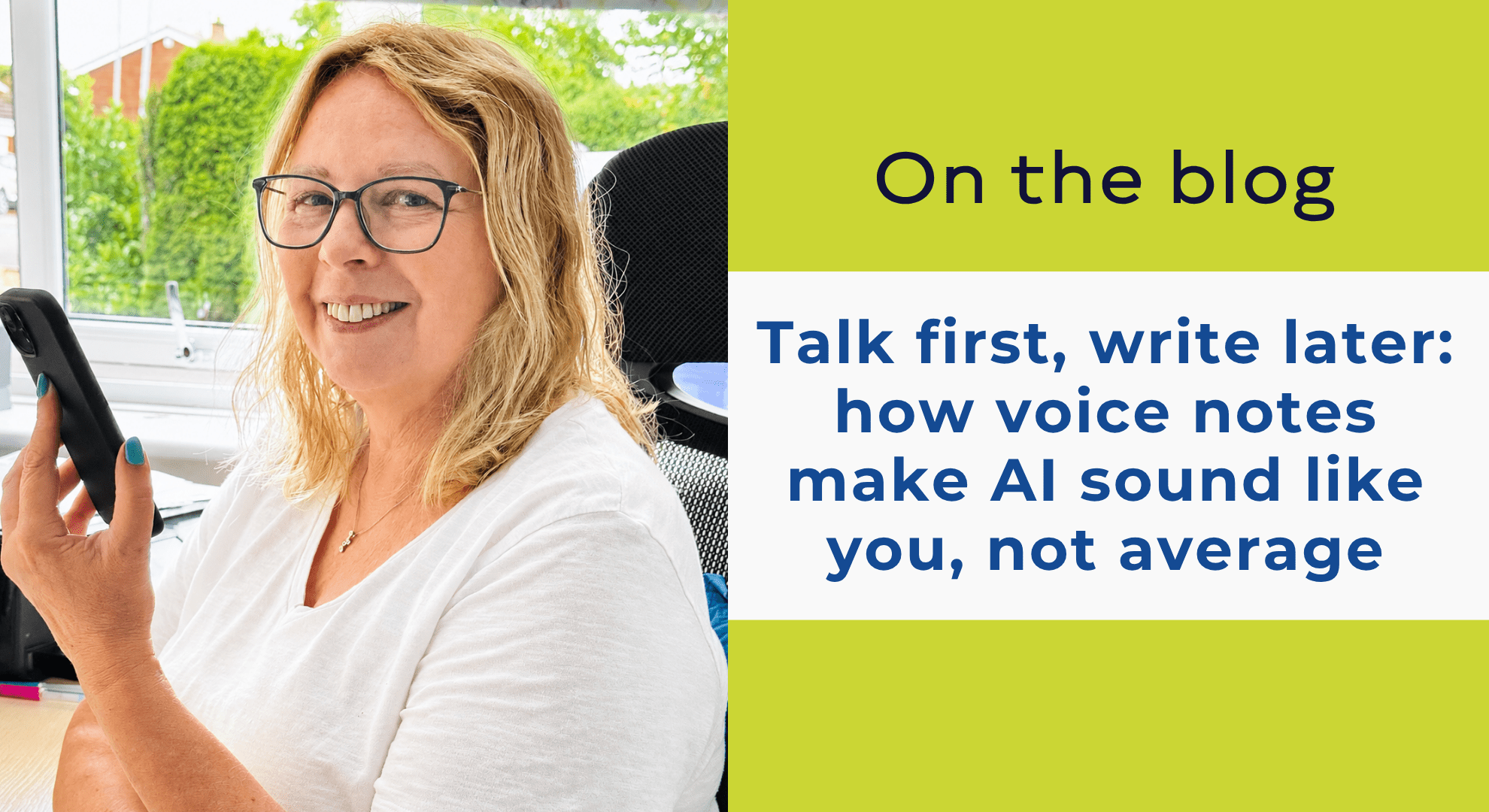
Recording a voice note before you write gets your real thinking down before the internal editor turns up. It works because talking and writing are two separate jobs, and doing them at the same time is what causes the blank page. Say it first, tidy it later, and let AI help with the second part, not the first.
I noticed this properly during a talk I gave recently, watching the room as I explained it. A few nods. A couple of people writing it down word for word. It’s not a new idea, but it seems to land differently when you say it out loud to a room than when you read it on a slide.
What I was explaining is that most people make writing harder than it needs to be. Open a blank document, and try to work out what you want to say and find the right way to say it in the same sitting, and you’ve stacked two jobs into one. Say it first, in whatever order it comes out, and the writing part gets much easier.
The blank page isn’t a writing problem
When someone tells me they’re stuck on a piece of content, they usually think the problem is that they can’t write. It’s rarely that. What’s actually happening is they’re trying to do two jobs at once: work out what they think, and find the right words for it, in the same sitting, staring at a cursor.
Talking removes one of those jobs. When you record a voice note about:
- a client win
- something a podcast got you thinking about that you’d like to write on
- an idea that came to you mid-walk
you’re not editing as you go. You’re saying what’s true. The thinking comes out messier, but it comes out complete. Nobody talks in tidy paragraphs, and that’s fine, because the tidying happens later.
I ask clients to do this before we build anything. Not write me three bullet points about your ideal client. Talk to me for two minutes about the last time a client told you that’s exactly it after you’d explained something to them, or something you keep noticing across your work. What comes back is always richer than what they’d have typed.
AI is better at editing than starting
This is where the AI part earns its place. Once you have a transcript, even a rough one full of ums and half-finished sentences, AI is good at finding the shape inside it. It can spot the sentence you said with real conviction and pull that out as the opening line. It can notice you made the same point three different ways and suggest which version is sharpest.
What AI is much worse at is generating that raw material from nothing. These tools are underneath the conversation exactly what they’re trained on: huge sets of existing data, good, average, and poor, scraped from across the internet. Ask one to write a LinkedIn post about client boundaries with no input from you and it will default to that average, because that’s all it has to draw from. There’s no experience in there, only pattern. That’s exactly why your context, your thinking, and your actual words matter so much. They’re the one ingredient AI cannot supply on its own.
I do this myself. I send a voice note straight into Claude, and it logs into an Airtable base I think of as my idea cupboard, along with the date, my thoughts on where I might use it, and a quick rating of how excited I am about it. Some of it never gets used. Some of it becomes the post I’m most pleased with that month. Either way, it exists, and it’s mine.
What this looks like in practice
Most of my clients keep it simple. A voice memo app, or a WhatsApp message to themselves, recorded straight after a good client call while the detail is still fresh, or on a dog walk when a thought won’t leave them alone. No script. No “content pillars” in mind. The observation, said out loud, roughly as it occurred.
The habit that makes the biggest difference isn’t the recording itself. It’s doing it before opening the laptop, not after staring at a blank document for twenty minutes first. By the time most people record a voice note, they’ve already talked themselves out of the interesting version and into the safe one. Catch the thought earlier and you get the real one.
There’s a practical edge to this now too. Since August 2026, new EU rules require AI-generated text, images and audio to carry a machine-readable mark showing where they came from. Anthropic was the first of the major labs to actually put that into practice for text, watermarking everything Claude writes, and the rest of the big providers have signed up to do the same. That doesn’t change what you should be doing, it makes the reasoning harder to ignore. If the tool itself is marking its own output as artificial, the only thing that was ever going to sound like you is what you gave it before it started.
Your best content was never hiding inside an AI tool. It was hiding in conversations you’d already had, the ones nobody wrote down. AI drafts. You’d already decided what mattered the moment you said it out loud.
FAQs
Do I need to write a script before recording? No, and scripting usually defeats the purpose. If you’ve planned what to say, you’ve already started editing, which is the step you’re trying to postpone.
What do I do with the recording afterwards? Get it transcribed, then hand the transcript to AI to find the shape inside it, the strongest line, the repeated point, the natural structure. You’re not listening back and writing from memory. The tidying is a separate task from the talking, and it happens once, not as you go.
I feel a bit daft talking to myself, does that go away? Mostly, yes, and faster than people expect. Nearly every client says some version of this after their first attempt, then stops mentioning it by the third. Nobody hears the raw version, only the tidied one, so the awkward bit is entirely private.
Does it matter that AI text is watermarked now? Not for what you’re doing here. A watermark only confirms a tool was involved somewhere in the process, it says nothing about whose thinking sits inside the words. I still send my own voice notes into Claude every week, watermark and all, because the mark doesn’t touch the part that was mine to begin with.